Injection & Handling Guide
"Pep 101": general, non-prescriptive reference material commonly referenced in the research community.
Research use only
All content on this page is general reference information for laboratory research contexts. It is not medical advice, is not intended to direct human use, and does not replace guidance from a licensed healthcare professional. Not for human consumption. Must be 18+.
Reconstituting a lyophilized vial
- Let the lyophilized vial and bacteriostatic water reach room temperature.
- Remove the flip caps and wipe both rubber stoppers with a fresh alcohol swab.
- Draw the intended volume of bacteriostatic water into a sterile syringe (commonly 1 to 3 mL per vial, depending on the concentration targeted).
- Insert the needle at an angle and let the water run slowly down the inside wall of the vial rather than jetting directly onto the powder.
- Do not shake. Swirl gently or leave the vial to dissolve on its own; peptides are fragile to mechanical agitation.
- Once fully clear, label the vial with the concentration and reconstitution date.
Use the peptide calculator to convert vial size and diluent volume into concentration and syringe units.
Commonly referenced subcutaneous sites
The diagram below reflects sites commonly referenced in the research community for subcutaneous administration in laboratory literature: the lower abdomen (avoiding a roughly 2-inch radius around the navel) and the outer thigh. It is reference information only, not an instruction to administer anything.
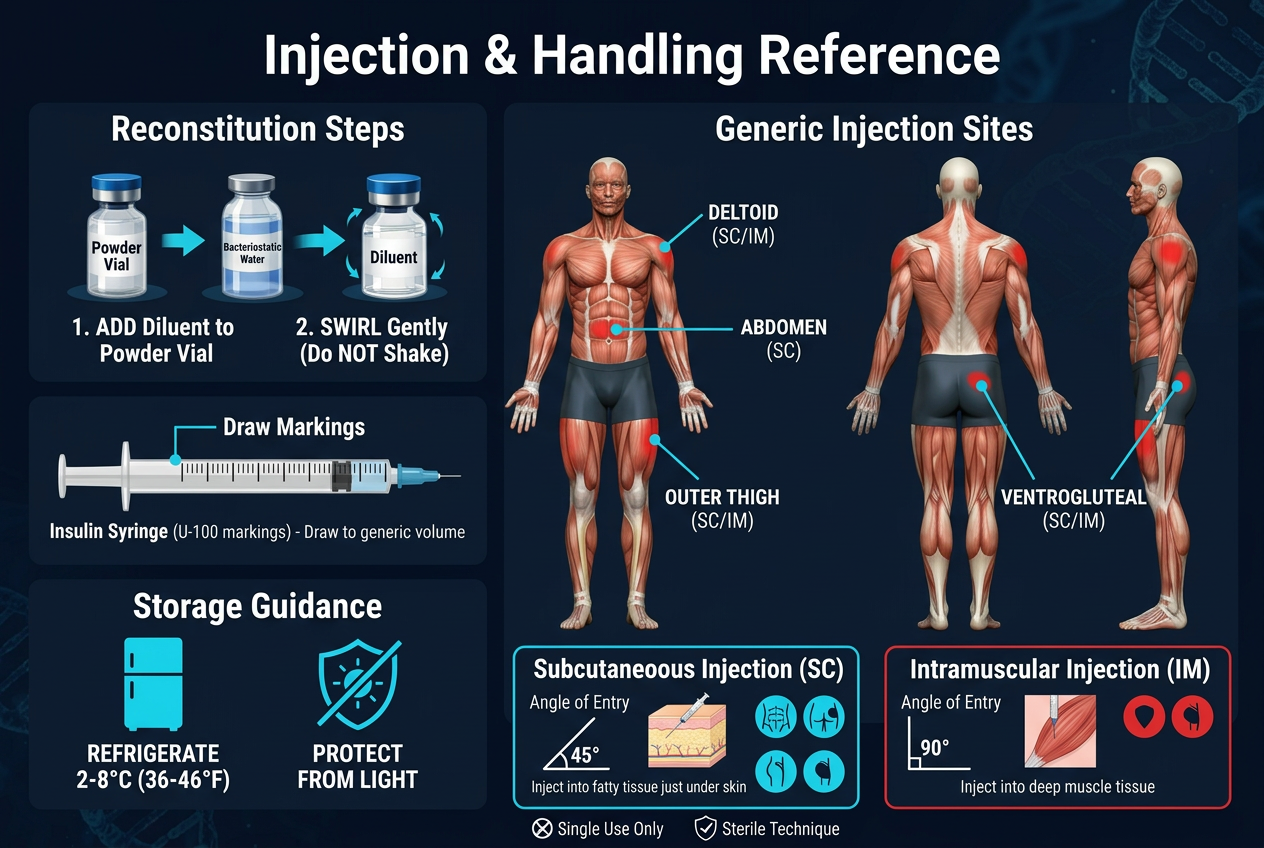
Rotation: literature commonly describes rotating between sites and shifting roughly an inch from the previous point each time, to avoid repeated trauma to one area. Consult a licensed healthcare professional before considering any use involving a person.
Storage & stability
- Lyophilized (unmixed) vials: store cool and dry, protected from light.
- After reconstitution: refrigerate at approximately 2 to 8 °C (36 to 46 °F).
- Protect from light; keep vials in their box or an opaque container.
- Avoid freeze/thaw cycles and avoid shaking reconstituted vials.
- Generic industry-standard guidance is to discard reconstituted material after roughly 4 weeks, or sooner if cloudy, discolored or particulate.
Sterile technique basics
- Wash hands and work on a clean, uncluttered surface.
- Swab every stopper with a fresh alcohol wipe before each entry.
- Single-use needles and syringes only: never reuse or re-sheath by hand.
- Never touch the needle or the inside of a cap.
- Dispose of sharps in a rigid, puncture-resistant sharps container.
- Do not use any vial that is cracked, unlabeled or past its handling window.
Research use only
This page is educational reference material for laboratory research contexts only. Nothing here is medical advice, a dosing recommendation, or intended to direct human use. Consult a licensed healthcare professional. Not for human consumption. Must be 18+.